Quick overview
By Scorechain Team
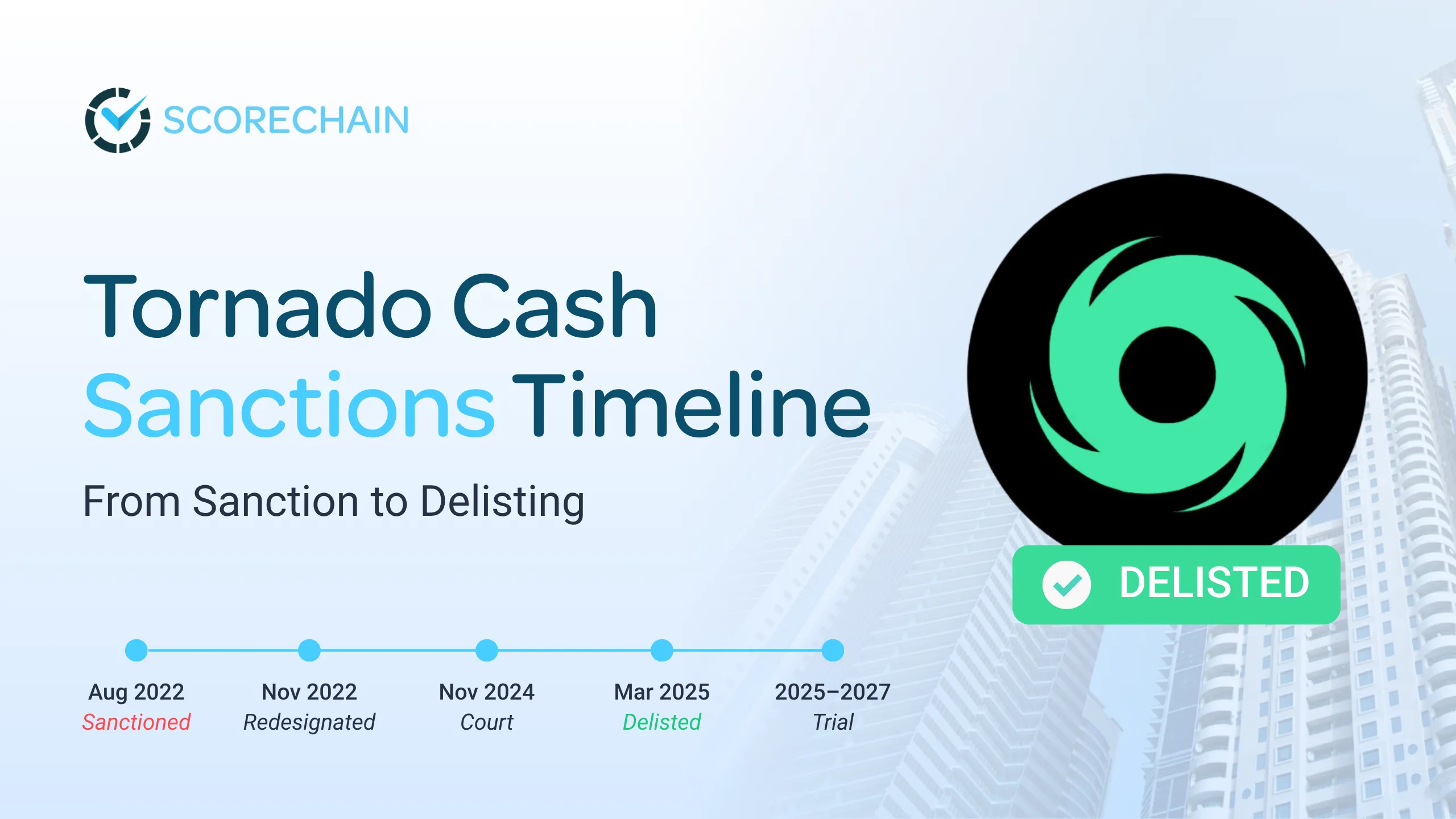
OFAC first sanctioned Tornado Cash in August 2022, redesignated it on 8 November 2022 and removed it from the sanctions list on 21 March 2025. This page sets out each step, what the delisting changed, and why mixer exposure still matters for crypto sanctions screening. The Office of Foreign Assets Control (OFAC) is the US Treasury office that maintains the list.
Tornado Cash is a well-known crypto mixer. OFAC first added it to the SDN list in August 2022. In that announcement, Treasury said the mixer had been used to launder more than $7 billion in virtual currency since 2019. On 8 November 2022, OFAC announced the redesignation in a press release under Executive Orders 13722 and 13694, as amended.
The update took into account new information on Tornado Cash's support of DPRK activities. OFAC said the mixer obscured the movement of more than $455 million stolen in March 2022 by the DPRK-controlled Lazarus Group, which it called the largest known virtual currency heist. The SDN entry also carries crypto addresses as identifying data.
A crypto mixer, or mixing service, is a decentralised service on blockchains. It lets users transact with more privacy by pooling funds from different users to obscure the trail of funds.
Users deposit a set amount of crypto assets into the service, which mixes them with other deposits. Users can then withdraw the amount they deposited without a traceable link back to the deposit. Centralised mixers typically charge a fee for this.
Many mixing services exist, and Tornado Cash was one of the best known and most used. It followed Blender.io, the first virtual currency mixer OFAC sanctioned, in May 2022.
On 21 March 2025, OFAC removed Tornado Cash and its associated Ethereum addresses from the SDN list. The removal followed the Fifth Circuit's November 2024 decision in Van Loon v. Department of the Treasury, which held that Tornado Cash's immutable smart contracts are not "property" that can be blocked under the International Emergency Economic Powers Act. OFAC kept the designation of co-founder Roman Semenov, and the Department of Justice continued its prosecution of the founders.
In August 2025, a Manhattan jury convicted Roman Storm of conspiracy to operate an unlicensed money transmitting business and could not reach a verdict on the money laundering and sanctions conspiracy counts. Prosecutors chose to retry those two counts, and the court has set the retrial for 26 April 2027. Storm's motion for acquittal on the conviction had not been decided as of early October 2026.
The 2022 action set out the obligations that apply to any party on the SDN list. OFAC said all property and interests in property of designated parties that are in the United States, or in the possession or control of US persons, must be blocked and reported to OFAC. It also prohibits dealings by US persons or within the US, including transactions transiting the US, that involve blocked property.
Persons that transact with sanctioned individuals or entities can face a designation themselves. Foreign financial institutions that knowingly process significant transactions for a sanctioned party could face correspondent or payable-through account sanctions. These rules still apply to parties that remain on the SDN list.
Tornado Cash addresses are no longer listed, but exposure to mixers remains a risk factor. Compliance teams decide how to treat that exposure under their own risk-based approach.
OFAC adds crypto addresses as identifying information when it sanctions individuals and groups. For example, in April 2022 it added Ethereum addresses to the Lazarus Group entry, as shown in its 14 April and 22 April updates.
Compliance officers need to check that they do not transact with sanctioned crypto addresses. Crypto wallet screening identifies direct and indirect exposure to sanctioned, illicit or high-risk counterparties and gives each wallet an explainable risk score. With transaction monitoring, teams set alert scenarios by amount, direction or risk indicator, including indicators for mixing patterns.
For a free check, the Sanctions Screening API screens addresses against OFAC, OFSI, MOFA and NBCTF lists. It returns whether an address is sanctioned, the sanctioned name, the sanction date and the blockchain, within a limit of 100 requests an hour. Teams that manage several sanction lists can combine this with wallet screening.
To see sanctioned addresses and mixer exposure flagged on your own flows, book a demo with the Scorechain team.
OFAC first sanctioned Tornado Cash on 8 August 2022. On 8 November 2022, it redesignated Tornado Cash under Executive Orders 13722 and 13694, as amended, and that action replaced the August designation.
No. On 21 March 2025, OFAC removed Tornado Cash and its associated Ethereum addresses from the SDN list. Exposure to mixers is still a risk factor that compliance teams assess under their own risk-based approach.
OFAC's blocking rules no longer apply to the delisted Tornado Cash entries, so the 2022 sanctions no longer bar US persons from dealing with them. Other laws and each firm's own policies still apply, and the criminal case against the founders is separate. Roman Storm was convicted on one count in August 2025, and the retrial on two counts is set for 26 April 2027.
OFAC took into account new information on Tornado Cash's support of DPRK activities. It said the mixer obscured the movement of more than $455 million stolen in March 2022 by the Lazarus Group.
Tornado Cash is no longer a blocked party, so the blocking and reporting duties from the 2022 action no longer apply to the delisted entries. They still apply to parties that remain listed, including co-founder Roman Semenov. Mixer exposure stays a risk factor under each firm's own risk-based approach.
A Manhattan jury convicted Roman Storm in August 2025 of conspiracy to operate an unlicensed money transmitting business and could not reach a verdict on two counts. The court has set the retrial on those counts for 26 April 2027, and his motion for acquittal had not been decided as of early October 2026.
Wallet screening shows exposure to sanctioned, illicit or high-risk counterparties. The free Sanctions Screening API also checks addresses against OFAC, OFSI, MOFA and NBCTF lists.